Showing posts with label Playing with Expectations. Show all posts

Tuesday, August 1, 2023

HOW GRETA GERWIG SET US UP FOR THE POWERFUL DEPTH OF BARBIE

I saw BARBIE over the weekend, and I have to say, I can't really think of the last time that I cried so much in a movie. 

This is not what I expected to have to happen at a movie about Barbie. Even halfway through the film, which was delightful, I did not see it coming. 

But in retrospect, it's all right there waiting.

I've been thinking a lot about how writer/director Greta Gerwig primed us for such a deeply emotional experience without giving away at any point that we were headed there. 

Here's five moments that I noticed which seem like key beats in that journey. 

1) The 2001 Opening

Starting a film about Barbie with a 2001: A SPACE ODYSSEY homage is random and hilarious. And the execution is just spot on. It's an absolute delight to watch.

But Gerwig sits on that moment of the girls smashing those dolls a long time, longer than she needs to. And they look truly furious.

In a sense that only adds to the sense of delight. But it also underlines the girls' rage and pain. And I think it's there to open us up to the possibility that that this story could offer more than we might think.

2) The Barbie Land Opening

Gerwig does something similar in the "proper" opening of the film. We are toured through a day in the life of Barbie and Barbie Land. And once again, it's hilarious in a thousand different respects. There is so much here to delight in. (Gerwig loves to use the comedy of the situation, which is really the comedy that we come to this film expecting, to hide where she's really going.)

But Barbie Land is also overwhelming. No one has any privacy. And how many times does Barbie have to deal with people saying "Hi, Barbie!" to her forcing her to respond? I want to say it's over one hundred. (It can't be, can it?) 

Until the dance at the end of that first day, Barbie takes it all in without a note of exhaustion. This is just her life and isn't it hilarious, is what the story is presenting. Meanwhile it's creating in us a sense of disquiet, a feeling that something is wrong. Again, priming us for a different, deeper kind of experience.

When Barbie asks "Do you ever think about death?" in a sense we're back to the laughs, and the film points us to think the story is going to be Barbie dealing with her problems, not her world. But in the end that's all going to come back around. 

3) The Older Woman 

When Barbie and Ken come to "our" world, once again Gerwig gives us lots of funny bits, particularly around Ken and his joy at learning about the patriarchy (and horses). 

Barbie's experience is much more unsettling to her. One of the great choices that Gerwig makes in this film is to allow Barbie to be authentic and present to her experiences. Things impact her; they beg questions that she considers. Why is she having these feelings? Why are people treating her in this way? 

(Compare that with Buddy the Elf from ELF. He, too, is from a fantasy world and enters our world an innocent. But self-awareness and self-reflection is something he learns only very slowly.)

Gerwig and Robbie are careful not to make the objectification Barbie immediately feels too serious. That first section on the beach ends, in fact, with Robbie standing up to the construction workers and saying she and Ken have no genitals.

Then we get this moment where Barbie simply sits by herself on a city bench, taking in what she's seeing around her. She's really feeling things.

Then she turns to look at an older woman, who looks back at her. And it's another one of these moments that goes longer than you would expect, which allows us to really be with them in that moment. (Robbie and the other actress—Ann Roth—are so good.) Then Barbie simply says, "You're so beautiful."

It's all so unexpected and genuine. Once again, it primes us for the depth of emotion that this film is going to deliver.

And also once again, it ends with Gerwig covering her tracks. The older woman stares at Barbie for a second, her face unreadable, and then says, "I know!" They laugh, and so do we. 

4) The Box

At the midpoint, the Mattel execs bring Barbie back to headquarters. And in response to her questions and anxiety, they tell her reassuringly that all she needs to do is get back in the large box they have waiting for her in the corner of the room. 

It's a very funny idea that they would have a human-sized box for a human-sized Barbie. It's yet another of a million ways that Gerwig adapts the ideas of the Barbie doll into the film.

But it's also an incredibly immediate and disturbing metaphor for the experience of women that the film is actually exploring through Barbie's journey. And Gerwig leans into it in wonderful ways: we actually see Barbie get into the box, which is in an of itself unsettling. Then the cords that hold the dolls slowly begin to tighten around her wrists, underlining what a nightmare this is. 

This is a brief moment. The box is never returned to. But the visual metaphor it offers absolutely captures what this film is really about, and where it's going. 

5) The Speech and the Character Head Fake

At the end of Act II, we come to the point that this whole film has been building toward, Gloria's speech about being a woman today.

Even as it begins, with Barbie having given up and Gloria and her daughter Sasha unsure what to do,  Gerwig gives no signal that this is going to be that kind of a moment. 

Instead, Gloria just starts talking about her own life, and the contradictions of it. It's thoughtful, but she's just thinking off the top of her head, reacting to Barbie's collapse. 

Only very slowly does it start to pick up steam. One contradiction leads Gloria to another, and another. America Ferrera as Gloria delivers a master class in how to make a speech feel organic and of the moment. 

And each new thought is put simply and concisely. Gloria is talking about her experience, but the particulars of her life have been stripped away to give us just the essential contradictions, which makes what she's saying immediately accessible and relatable to the audience. Without even knowing how it happened, suddenly we're right there in the middle of it with her, and she's talking about our lives. And the emotion of it all just rises up.

(As someone who wept profusely watching this, I was reassured to read Gerwig's anecdote that when filming the scene she noticed men on the crew crying, too. 'They have their own version of this sense of being trapped,' Gerwig said.)

Part of what makes the scene land so hard is the quality of the writing and performance, that simplicity and resistance to any language or affectation that would make the scene seem artificial or monologic.

And the other part is that Gerwig gives this moment not to Barbie but to Gloria. Given the content,  this moment absolutely couldn't be delivered by Barbie, right? There's just too much life experience behind it. 

But still, in a film called BARBIE, you definitely don't think the big moment is going to come from someone else. And so we don't see that move coming. 

And at the same time, the script has been setting us up to be open to this moment all along. 

++

Lots to be learned here. Here's three of my takeaways: 

If you know the expectations of your audience—this movie is going to be silly; the protagonist always gets the big speech/moment—you can use those expectations to surprise them.

Comedy can be a great means of distracting your audience, and a great place within which to hide things.

A visual metaphor can do much work to express the deeper conflicts or themes of your story.

++

There are so many great writing techniques in this film. I hope to write about some more over the next week.

(Other things I'm planning to write about soon—GOOD OMENS, Season 2! STAR TREK: STRANGE NEW WORLDS meets LOWER DECKS! OPPENHEIMER!

See you there...)


Wednesday, December 21, 2022

WHITE LOTUS FLIPS THE POINT OF VIEW


WHITE LOTUS 206 has so much we can talk about. Wow wow wow. 

For today, let's talk about Point of View. There's such a big POV shift in the Ethan and Harper and Cameron and Daphne story. In the first 5 episodes, we get to see the world through each of their points of view, but the central character is clearly Harper. She's the one whose fears and neuroses are on full display from the start, and she's the one driving the conflict. (You could definitely say Cameron and Daphne are drivers, too, especially Cameron. But really do they ever seem like subjects of their own? No; they're antagonists in the Ethan and Harper story, much as Quentin is in Tanya's.) (Oh God, poor Tanya.)

With the Cameron and Ethan party, we begin to a shift. We start to see the world through Ethan's eyes as well as Harper's. She's calling him and he doesn't answer. Meanwhile he's curled up in his bathroom while Cameron is having sex with two prostitutes. 

But even so, Harper is still the one driving the story, doubting Ethan, and then in this episode asking the really hard questions.  But with that—and specifically the moment in which Harper goes with Cameron to get drinks—the balance radically shifts to Ethan, and his growing fear that Harper cheated on him with Cameron. It goes so deep into his head, in fact, that we even see him imagining Harper and Cameron having sex when Ethan comes to the door. (In a sense that moment parallels Harper's wild fantasy/experience of all the men stalking her.)

We haven't lost Harper's point of view entirely; Mike White regularly cuts away to her considering Ethan as he grows more and more paranoid, but the focus is really on Ethan and the fact that he doesn't know what happened. And neither do we, a position that makes us identify with him all the more (even as he is clearly losing his shit and not at all recognizing this is the position he has just put Harper in).    

I'm not sure when the last time was that I saw a show do anything like this. But I think it illuminates how we can play with an omniscient point of view, as you often use with an ensemble show. Withhold something significant that someone has done in an omniscient show and we can generate a lot of audience interest and surprise, precisely because we've taught them to expect they'll be told everything.

And yet doing so doesn't feel like it breaks the rules of the show, I think because White doesn't fully shut Harper's POV out, and because the hypothetical of her with Cameron has been set up multiple times (even if it seems mostly preposterous). (Cameron is so awful.) 

Your mileage may vary on all this, but for me the real takeaway is to consider the POV of my piece and consider what sorts of expectations that seems to build in viewers. The more I understand what I'm teaching them, the more I can later fuck with them.  

TOMORROW: I really want to go on to 207 but there's so much here! So I'm going to spend one more day on 206, and then do the finale.  (And then I may go back and do a few more odds and ends on the series. There's so much here!)

Wednesday, September 21, 2022

EUPHORIA KNOWS THE POWER OF KNOCKING DOWN YOUR EXPECTATIONS

For me EUPHORIA 206 runs in parallel with 203. In both episodes we're dealing with our "villains", Cal (203) and Nate (206). And at first 206 seems like it's going to take us through the same humanizing moves. Cal was in love with another boy as a kid and then had his life turned upside down. Nate, we learn from his mom, had something terrible happen at 9 and then changed. 

But where 203 builds on that introduction, in 206 its echo is really a sleight of hand set up. We expect more pathos, but instead we get Nate breaking into Maddie's apartment, drawing a gun on her and threatening to kill first her and then playing Russian roulette with himself until she reveals where she has the DVD of his dad having sex with Jules. It is one of the most disturbing moments in the entire show (and honey, that is saying something). 

The crazy thing is, the episode refuses to leave us with our renewed understanding that Nate is a Monster, either. He brings the DVD to Jules so that she can choose what to do with it; and he's nothing but good to her, although given what we've just seen we spend the whole sequence living in fear for Jules, a brilliant choice on writer Sam Levinson's part. It's such a great technique to remember: Each character scene delivers an emotional package that we the audience carry with us into the character's next moment (and sometimes just the next moment period). If you see Nate threatening to murder Maddie in scene one, we are definitely going to be terrified of him the entire next scene, no matter what. 

And even at this point we're not done with Nate. He calls Cassie and tells her she's coming home with him, which while not as bad as holding Maddie at gun point is definitely messed up.

The roller coaster of all this serves a character purpose, right? By the end of the episode we no longer have any idea what Nate might do next. The writing has effectively blown past our expectations so many times that there's really nothing left for us to do but surrender. Which is terrifying, and also exactly what Levinson wants us to feel when it comes to Nate. 

In a lot of shows that I've written about, we've seen a writer do one twist on expectations. And that seems to fit the structure of TV: a character enters with a problem or question, and the ending should resolve that issue in an unexpected way, but also one that builds over the course of the episode. 

But in 206 Levinson makes it clear there's more room to play with expectations than we might think. You can overturn expectations far more than just once in one ep. And if you do it well (i.e. it's justified, not just random twists for the sake of twists, which an audience will always recognize on a gut level), the power of those twists upon the viewer grows almost exponentially.

Monday, May 16, 2022

BARRY RISKS EVERYTHING


BARRY 303 and 304 have an interesting dynamic vis a vis the season storyline of Barry saving Mr. C as a way of earning forgiveness. 

In 303, Mr. C does the part, because Barry threatens to kill his family otherwise. But then at the end, instead of delivering the line he explodes all over Barry and flees. And there's a certain definitiveness to Barry's read on it, like he's failed. 

In 304, though, that redemption arc story continues in two ways. First, Barry's plan is unexpectedly working despite Cousineau's rejection. the director of the TV episode where Cousineau ignored the script and attacked Barry ended up loving his performance and wants him back. And the story Barry told about Mr. C saving his life has gotten into Variety. Suddenly he's a hero. 

At the same time, we follow Barry doing a group assassination for Hank. And it seems like he's given up on life, but then in the end he brings that money to Cousineau. It's not about earning forgiveness any more, it's just about trying to pay back a debt--which obviously is a much more selfless thing. 

I love the sleight of hand of giving Barry a job whose significance we will assume we know from past experience and then revealing it has a different purpose. It's a great example of playing on audience expectations to generate a wonderful experience of surprise.  

But what's equally satisfying is the way that big choices lead to unexpected rewards.  Cousineau risks EVERYTHING by telling Barry off, and he is rewarded for it. 

(Similarly, Katie risks a ton in 304 to be honest with Sally, and that, too, has enormous positive consequences. And we could say 304 shows Sally's huge risk in writing and producing her own show paying off, too. God it feels good to see her get a real win.)

Every show is different, but I'd say that most TV shows exist in a universe in which big risks that involve high personal stakes produce big rewards, even if they're not the rewards the character expected. 

It's a good question to bring to our own work: If my characters succeed, how much have they risked to get there? If our answer is not, "Pretty much everything," we may need to up the ante.

Sunday, March 20, 2022

ELDEN RING SMASHES ALL YOUR EXPECTATIONS OF STORIES

Got sidetracked last week. Sorry about that! I'm back now with an assortment of story ideas and techniques drawn from a variety of different kinds of storytelling. 

Today, I want to talk about ELDEN RING, aka the thing that is currently ruining my life. My sister bought it for me as a belated Christmas present, and it's nearly impossible to stop playing. 

But I'm realizing that what makes it so compelling is actually the fact that it has straight up refused to build its world and story in the gradual, let's learn one step at a time way that almost action adventure every video game does. Almost as soon as you enter into the world you are confronted with monsters that you will never be able to defeat for a very long time. 

 And everywhere you go it is like that. There is a sort of training module if you can find it--I didn't stumble onto it until I'd been playing for almost two weeks. And honestly, even though it was basic it was still helpful, because the game has so many different mechanics going on it's just really easy to not know how to do stuff. Almost from the beginning we are told that people can jump between dimensions, and now on more than occasion I have been killed by someone who did just that. But there is so much more basic stuff that I have yet to master, I can't even predict when any of that is going to make any sense.

I know I'm supposed to put the Elden Ring together, but how is completely unexplained. You just wander around (mostly getting killed by monsters) and little by little you learn stuff. 

Video games have their own mechanics and there are some things you might be able to get away with there that might not work in say, a television show.  But I don't know, the more I play the more I wonder whether there isn't more room to experiment, particularly with regard to how much you spoon feed your audience. TWIN PEAKS: THE RETURN was endlessly impossible to get your head fully around, and yet I would say it's probably the greatest season of television I've ever seen. The ending of season one of EUPHORIA was much the same. I don't know what the hell was going on with that crowd scene, but it was incredible and I felt so lucky to have seen it. 

Being difficult for difficulty's sake doesn't work. The audience almost instinctively knows that's what you're doing and most will walk away. But if the challenge you pose to the expectations of your audience  actually serves the story, I honestly wonder if there's a limit to how difficult or outside the box you can be. 

There's a principle in improv that might also apply: if you do something and it fails to land, do it again. By the third time, the audience will love it simply by virtue of the fact you've taught them to expect it.  

I wonder if challenging expectations is similar. If you're going to do it, don't go halfway. The more you push--again, assuming you're serving the story--the more the audience will rise to the challenge.

Sunday, November 14, 2021

SHANG-CHI AND THE SUPER HERO ORIGIN STORY

I've got some more to say about ONLY MURDERS IN THE BUILDING this week, but I wanted to break in here at the top of the week with a little piece about Marvel's SHANG-CHI AND THE LEGEND OF THE TEN RINGS, which I finally saw over the weekend and liked a ton more than I expected to. 

I'm a little burnt out on super hero storytelling, and maybe also the Marvel method of an origin story, which normally involves the main character a) making a big mistake which motivates their drive to be a hero; and b) some family member and/or person with the same power as them being the villain. 

Both of these things in fact do prove to be true in SHANG-CHI (sigh), but there's some pretty creative differences in the way the film does the origin story, too. If you're looking for some ideas on how to mix things up in your own work, here's what writers David Callaham, Destin Daniel Cretton and Andrew Lanham came up with. 

1) Bury the Lede: The typical super hero origin story literally follows the hero through the whole process of getting their super power and everything that ensues from that. 

SHANG-CHI looks like it's going to do the same. When we meet the adult "Shaun" he's just a hapless hotel car attendant. It's all very Spider-Man. But then suddenly after we've got to know him and his friend Katy, he's attacked on a trolley car and reveals to us--and her--that he is this bad ass martial artist. 

Basically, the writers know our expectations, and play into them, precisely so they can then surprise us.

2) Disrupt the Story: Another typical move you see in hero movies is some sort of flashback narration about what happened before, how the character got to this point. 

And once again, the writers lean right into that expectation so as to mess with us. Shang giving a very serious monologue over flashbacks of him learning to be an assassin and then being sent on his mission. 

But before we can find out what happened, we cut to him and Katy on the plane to Macau and the airline attendant asking their meal order. And it's not a momentary gag. It has three beats actually--the query; finding out the airline doesn't have what they requested; and then the query again. By the time it's over there's just no going back to the story. Which actually ends up delighting us, precisely because it is so unexpected. 

3) Vary the Conventions: So again, there are two big conventions in the Marvel origin story: the hero has some reason to redeem himself; and his enemy is a relative or someone with the same powers.

SHANG-CHI has both, but varies them in some interesting ways. It hides that Shang has anything to redeem for a very long time. He actually tells Katy he didn't kill anyone as an assassin, and his training is painted as his father's doing, when in fact he agreed to it (though as a young and traumatized child). It's not until the end of Act Two in fact, that the truth is revealed. Which as the low point of the story, and the moment Shang has to make the decision to step up, is a great place for that kind of reveal anyway.  

And then on the flip side, while the dad is presented early as a straight up villain, Act Two then keeps turning over cards that humanize him further and further. First we find out he thinks their mother is still alive somewhere, and that's the motive for him stealing their pendants and them. And that could be enough, really, to make him more than the standard bad guy. Certainly you walk away from the first half of Act Two thinking you've been told all there is to know. 

But then we get the reveal that his dad loved his mom and them so much he actually gave up being a supernatural crime lord, after 1000 years of doing it. And it was only the murder of his wife that set him back on that path. 

So where the beginning suggests we're in GODFATHER territory, basically, the bad family coming to take back their son, the story keeps flipping over cards to say actually no, this father figure is much more interesting. He's a guy who found his way to a kind of redemption and then lost it.   

As Marvel has honed its storytelling this kind of approach to a villain has become more the norm. Think: Thanos or Vulture. But even so, SHANG-CHI represents innovation in that it only shows us Shang's dad's goodness gradually.

Monday, September 27, 2021

EMMYS 2021: THE CROWN


This week I'm featuring some of the 2021 Emmy winners. 

The Premise: The season 4 finale, entitled "War" and written by show creator Peter Morgan, features the culmination of the main storylines of the season--Margaret Thatcher's Prime Ministership; Thatcher's conflict-ridden relationship with Queen Elizabeth; and Charles and Diana's marriage. 

Structure: On the surface, "War" looks like what I'd call a Hand Off plot. We go back and forth between the two main wars of the ep--Thatcher's reign and the marriage. Then once Thatcher and Elizabeth have their final moment, the rest of the ep is handed off just to the marriage. Thatcher's story is like the booster rocket that propels the marriage story to its conclusion. 

But that's only partially correct. In fact, once Charles and Diana have it out--in a scene that follows directly after the Elizabeth/Thatcher moment--the last 15 minutes is actually about a bigger war that's been going on the whole series, and that is everyone's humanity and happiness versus the responsibilities of the crown. Charles and Diana think they're on opposite sides, but as they interact with Elizabeth and Philip, we learn that in fact they're both dealing with the same thing: that damn crown. And while each enters into that last section thinking they've won--Charles has told Diana he's not doing this anymore and Diana has established to herself that she has autonomy and is not the crazy person he wants to be--by the end they've both been crushed in the war they forgot they were in, and that Morgan has not called attention to until the end, so that it's a twist for us, too. 

At the same time, I do think the Thatcher story serves as a kind of booster rocket, insofar as she establishes a key either/or of the episode: either you act and thrive, or you do nothing and live in ignominy. Elizabeth tells Thatcher she could use a little  more "do nothing" at this point, but in fact in the end Elizabeth comes around. Calling Thatcher in, awarding her the Order of Merit and having her wear it out--these are very concrete actions that she takes, and impactful ones.  

In a sense Charles has been giving Diana the same advice as Elizabeth to Thatcher--do nothing. Stay home. Shut up. But here in the finale she finally refuses that take on her life, which has absolutely been killing her, and discovers a life for herself. 

So again, we enter into the final sequence having been "taught" that action really is the right thing, only for Diana and Charles to be told very clearly, stop acting. It's a brilliant set up/take down on Morgan's part, and one that only gets more satisfying the more times I watch it. 

Keys to the Kingdom 1: The Title

One of the things I love about THE CROWN is that it often gives episodes titles that provide a sort of lens for understanding what we're going to see. Morgan calls this episode "War", and then begins with a sort of classic pre-war sequence--Sir Geoffrey Howe getting up, dressing, considering his speech--all steps in literally preparing himself for battle. Finally he walks through the Parliament in a classic warrior coming into the amphitheater sort of shot. 

Obviously Thatcher's battle to maintain her leadership will be a kind of war, and Charles vs. Diana too. (There's that great moment in their story where the two sides confront each other across a table.)

But war floats through in other ways, too: William's soccer game; Diana's struggle with her mental health; radio stories about violence in Ulster; Camilla's take on fairy tales as beginning with someone being wronged, which is exactly how wars start as well; the stag horns that surround Diana as she goes down to take a family photo at the end, evidence of the generations of victims of a whole other kind of war. And the Christmas visit as a whole has a sort of war vibe, not because of Charles but because the family is so to itself--Diana looks here and there for an entry and finds nothing. 

A great title is so useful for the writer; it becomes a way of focusing everything in an episode. 

Keys to the Kingdom 2: The Repeated Image

"War" begins with Sir Geoffrey--a man we do not know--waking up. As we discover who he is, the significance of beginning with him waking up becomes clear. His whole story is about calling the party to wake up to the disaster they're in with Thatcher. 

That image of a person getting out of bed repeats twice more in the episode. (The rule of three--it's always happening. Elizabeth likewise gets three scenes with Thatcher.) The first time is Diana in New York; so far she's been lost in her own anxiety. But then we see her in bed in New York. She sits up, hears the sounds of the city--just as we started with Howe hearing the song of the birds. And out of this comes this great day, in which she really does good and discovers an identity of her own. So again the physical waking up bespeaks a metaphorical one.

Near the end we meet Diana in bed again. But this time she's hiding from the nightmare of Christmas with this terrible family. What rouses her out of bed is Philip's knock. And this time--in keeping with the end-reversal Morgan has going on--getting up and standing up to Philip only leads to her foundering on the rocks. The crown is so much more than any of them can withstand. 

But still, the last shot of the episode is Diana, standing alone. And even as tears start to well in her eyes, she begins with what looks to be resolve. The challenge of the battle to wake up and be oneself presented so clearly in that moment. 

Again, most dramas don't have this level of thought going on in the writing. But THE CROWN always does and it's well worth watching literally any episode just to see these kind of novelistic flourishes at work. 

Keys to the Kingdom 3: Philip's Speech

There's so much more that I could say about this episode--particularly Elizabeth's journey with Thatcher, which is so interesting. But having written so much already, let me just end by highlighting Philip's astonishing end speech. It comes in a sequence that doesn't look like a battle, him advising Diana, but then ends up being revealed to be one when she refuses to simply accept that everything's going to be okay eventually. His demeanor completely changes after her words, and he then gives this incredible speech about how none of them are anything, the only thing that matters is the Crown. 

That speech IS when Morgan makes clear what the "real" war has been and where Charles and Diana stand in it. But it's also the moment that brings the series back to its broader themes, which are all about the horror really of being a part of this family, the brutal, dehumanizing burden of self-sacrifice that is asked of everyone around the crown. Those themes obviously wind their way through this season as the others--in fact Thatcher in a sense is the mouthpiece of that way of thinking (and its absolute inhumanity). But this season doesn't cohere around that idea in quite the same degree as past seasons until that speech. And then suddenly it's like someone has pulled down a curtain and revealed um, yeah, this is still a part of the whole story Morgan and his team are telling. 

The note to take being, when you're writing a season finale, you're always speaking to the themes of the season but also those of the overall story. Or at least that opportunity is there--and it's a great one. 

Now You Try

There's a lot here to consider playing with. One idea might be to look through a script you've been working on and see if there isn't some kind of image that you haven't already established that could recur. Or maybe you create one--but I suggest first look and see if there isn't the seed of one already there. Often there is. (Brains are amazing.)

Another idea might be to see whether there's some way to lead your audience to believe success for your character looks like one thing, and then provide that and reveal that is not success after all. Playing with audience expectations, there's nothing like it.

Friday, September 3, 2021

"CHUCKLES BITES THE DUST" DAY FIVE: LYING TO THE AUDIENCE

Every TV episode has a problem, right? A conflict or question that lies at its heart and is going to get resolved by the episode's end. On some of the best shows that resolution will only create new conflicts and questions. And really most shows it's probably more than one; certainly in ensembles or dramas that's the case. 

The problem of "Chuckles"--the battle between sobriety and laughter--plays out very concretely scene to scene. Over the course of scenes we see more and more people coming around to the idea of having a sense of humor about death. When Lou has Ted do an on-air eulogy, he's very serious about it, and Ted's intention is clearly the same even as what he has to say is ridiculous. 

But then as Murray tells Lou jokes Lou slowly converts to the cause of absurdity. Then Sue Ann. Then we get that intensely dramatic scene where Mary comes down HARD on them. (I'm going to post something about that scene sometime soon. It's so well written.)  So the comic is clearly on the rise, but it has not won the day.

We end on the comic winning out in the most hilarious and total way possible, in a sequence that physically embodies the very conflict of the whole episode. Mary literally sits there fighting to keep from laughing, until she can't. 

You could end the sequence on that note, and you'd be fine. The problem has been resolved. Comedy wins the day.

But genius that writer David Lloyd is, he adds one more beat--the minister telling Mary Chuckles would want her to laugh, which makes her burst into tears. In fully embracing the comedy of the moment, we also fully comprehend the loss. And it's so unexpected it's also funny. Having set us up to think our only options in this moment are laughter or tears, in the end Lloyd reveals a third option we didn't see coming: both. 

(He's actually been seeding that possibility all the way along--Lou and Murray stopping in the midst of their jokes to have a very serious and thoughtful conversation about why we laugh in the face of death; Georgette's comments.)

In part this is just me saying "Isn't that great writing?" But there is a lesson to be learned here, too. Lloyd set up the audience to see the episode going one way: eventually Mary's going to break. Eventually comedy's going to win. And more generally, that comedy/sadness is an either/or. And because he's done that, when she bursts into tears we are truly surprised. It's the definition of sleight of hand; he's got us looking at the left hand while we should be looking at the right.

We can do the same thing in our scripts. It's not the kind of thing you might put together in your first draft, mind you, but once you've got a draft, we can step back and say, what expectations have I set up in the audience at the start of the script? What's the problem that I've established? 

And then how can I use those expectations to surprise? If I've given the audience an either/or, what's the third way they won't see coming. 

As writers we're always trying to get as something true, but we're always liars too, telling people to think certain things only so that we can then undermine them.

Monday, April 19, 2021

BEST ADAPTED SCREENPLAY 2021: THE WHITE TIGER THROWS A HEAD FAKE

This week I'm looking at some storytelling takeaways from the 2021 Oscar Nominees for Best Adapted Screenplay.  
 

Ramin Bahrani's THE WHITE TIGER, based on the novel by Aravind Adiga, starts with a horrifying moment--a young, rich, maybe drunk couple run down a little boy while they're fooling around. In the backseat our protagonist Balram watches, horrified. 
 
This is the key moment of the film. It will set Balram down his harrowing path, and it tells us exactly what we're in for. 
 
Except as we hear the car running over the body, the film freezes frame on Balram's shocked, somewhat silly-looking face. "Pardon me," he says in voiceover. "This is no way to start this movie. I am Indian, after all, and it is an instant and venerated custom of my people to start a story by praying to a higher power."
 
And just like that, the film seems to signal we're actually in the realm of Tarantino. The shocking sound of the car hitting the body plays into that; it's so awful to have heard that the idea the film might somehow be a comedy (as insane as that is from the outside; they killed a child) comes as a welcome relief. Maybe they didn't hurt that child after all. Or maybe somehow it won't matter.
 
The film moves on and we come to know Balram, first far in the future of the opening and then before it happened. In both cases, the story is constructed around absurdly funny kinds of ideas: in the future he's writing a letter to Chinese Premier Wen Jiabao, in fact his entire narration is a letter to woo Jiabao to meet Balram on his upcoming state visit to India. 
 
 
Meanwhile in the past he's this skinny, put-upon poor kid who has made it his quest to become the rich master's son's driver. And he chases that dream with an infectious over the top enthusiasm that once again signals comedy, not drama. 

There are beats along the way that are quite dark. He has the chance to go to school but is prevented by his controlling Grandmother. When he gets a job with the son he immediately sets to undermining the guy above him, and ends up using the man's religion to blackmail him into quitting. 


But still, Balram is so winning that these momentary alarm bells don’t make you realize just how fucking dark this movie is going to get.

And that's how it so happens that when we find our way back at the horrifying moment of the child being run down, and the movie becomes the story of Balram being betrayed by the people he's trusted, and how he responds, we're surprised. 


In an awful moment, if you give the audience a chance to look away or feel something else--if you give them an escape--they will take it. 


Knowing that gives you another way to surprise them.   


Takeaway Question: What's the story I'm telling? And what's the story I want the audience to think I'm telling? 

Tuesday, April 13, 2021

BEST ORIGINAL SCREENPLAY 2021: PROMISING YOUNG WOMAN PREYS ON OUR EXPECTATIONS

This week I'm looking at storytelling takeaways from the 2021 Oscar Nominees for Best Original Screenplay. 

One of Emerald Fennell's PROMISING YOUNG WOMAN great strengths is its use of audience expectations.

The film presents itself as a classic revenge story. Cassie (Carey Mulligan) is a former med student intent on punishing the monsters who harmed her best friend Nina. We begin in Act 1 with setting herself as a target for the various creeps who take advantage of vulnerable women, only to then turn the tables on them once they think they have her.

Act 2 sees her moving up the through the food chain punishing those involved with Nina's death: the former classmate who didn't believe them; the dean who did nothing; the lawyer for the rapist. 

Finally in Act 3 we get to Al the rapist himself. Cassie shows up as the stripper bought for his bachelor party. Getting him alone, she handcuffs him to the bed and prepares to cut Nina's name into him. 

Then, he breaks free. Which fits the genre. It's the hero's journey--the hero has to confront their demon in order to be free. And it has to be difficult; it's the hardship they go through both to get here and now that earns them their victory.

Except that's not how this goes. From Fennell's script (which you can download here):

BAM!- He breaks a hand free from a handcuff and grabs her by the throat. CASSANDRA is caught off-guard.


He turns her onto the bed, to get both hands around her throat. She struggles. He’s choking her.


AL MONROE You asked for this. You fucking asked for this. This is your...fault.


CASSANDRA is looking at him. She can’t breathe.


She somehow slips out of his grasp. There’s a struggle, with AL’s hand tied to the bed they’re evenly matched, she manages to get her hand free again and she raises the scalpel.


It looks like she might win when, at the last second, AL catches her arm and twists it. The scalpel falls to the ground.


He wrestles her back down onto the bed. One arm on her neck, pushing down. He starts to cry.


AL MONROE (CONT'D) This is your fault...


 He can’t look at her. He grabs a pillow puts it over her face.


He climbs onto her head, kneeling on the pillow, smothering her with his knees. The one hand still handcuffed to the bed. It’s clumsy. It is going on for much too long. It feels like forever as she struggles underneath him. Every second we’re waiting for her to turn things around.


She tries to fight back, her hands scrabbling over him. She scratches his neck, but she’s running out of air. Her face hidden. AL is really sobbing now, kneeling on top of her.


Finally, after a long time, her body goes limp. Her arm falls, lifeless, to the ground.


AL stays on top of her. Crying. He climbs off tentatively.


We wait for the Fatal Attraction moment when she springs back to life. It never comes.

Even though Cassie's whole story is about how life for women is anything but some Joseph fucking Campbell archetype, having set up the story in the standard way, we don't see Cassie's end coming. Fennell has used the conventions of the genre to distract us from what's coming.

In the scene that follows, Fennell plays upon our knowledge of genre again, delivering what she describes in the script as "the beginning of every bro comedy where a guy accidentally kills/hits/hurts a sex worker. We’ve seen this trope before. Guys hurting women. Guys covering for their friends. We are familiar with this scene." 

It's a pitch perfect delivery, right down to the antic absurdity of those kinds of scenes.

JOE: Hey man. This is not your fault ok?

AL MONROE (sniffing): I don’t know...it kinda seems like it is...

JOE: No, it’s not!

AL MONROE (crying): Am I...am I going to jail? What about the wedding? What about my job? Anastasia is going to be so upset. No one will understand...

JOE: It was an accident though, right?

AL MONROE: I mean-

JOE (firm): It was an accident, Al.

AL MONROE: Yeah. Of course. I mean, of course it was!

The scene reinforces the significance of Cassie's murder, that the actual state of the world is not just justice or hero journeys but bros helping bros murder hoes. Just the fact that Fennell gives Al this scene of his own, and also lets that prior scene end not with Cassie's death, but with Al's freaked out reaction to it, says everything about who is the real subject and who the object in our reality. 

It also suddenly implicates us in the audience, who have likely watched these kind of bro comedies for decades and never thought twice about the women in them. 

From the start this was a film about a woman playing upon others' fucked up expectations. In the end, it turns out Fennell has spent two hours doing the same thing to us. And she does so by "hiding the knife" behind all our genre assumptions.

Takeaway Question: What kind of expectations might the audience naturally be bringing to my story? How can I play on them? 


Wednesday, April 7, 2021

CHARACTER WEEK: HAPPY VALLEY SAVES THE SELF-PITYING DRUNK

This week I'm looking at some examples of the ways that shows introduce characters.

During the pandemic I spent a lot of time rewatching shows I love-FRINGE, HALT AND CATCH FIRE, PARKS & REC, BABYLON 5 and THE WIRE all featured heavily in the rotation. In fact it was watching these shows and then wanting to outline them or think about how they worked that got me thinking about creating this blog.

HAPPY VALLEY was another on my Must Watch Because Pandemic list. It's a Sally Wainwright creation, and stars the brilliant Sarah Lancashire as  Catherine Cawood, a police sergeant running the shop in her small West Yorkshire town while grieving her daughter's suicide and raising her grandson Ryan with her sister Clare (the equally marvelous Siobahn Finneran). 


Wainwright's introduction of Catherine is masterful not only for the way it establishes  her character but the world of the show. Thanks to the wonders of the internets (and the fact the show is a bit on the older side, at this point) I can post it here so you can enjoy it for yourself. 


We start in media res, with the situation established pretty quick--drunk guy wants to light himself on fire because his girl's been cheating, while others in the housing project watch (and in some cases laugh). 

It's immediately clear, we're not dealing with a world of criminal masterminds here. This is the hardscrabble meets the absurd. 

From the moment we meet Catherine she knows exactly what she needs--not just a fire extinguisher, but sunglasses to protect her eyebrows; and she knows what to do--keep him talking and try to distract him from himself, a goal that Wainwright also uses brilliantly to thumbnail (in as few as a couple dozen words) Catherine's family members and key life issues: she's 47, divorced, her sister is an addict, her daughter is dead and her son won't speak to her.

That's it, that's the opening. There's no big rescue, no calisthenics, no violence--none of the things you would normally get to introduce the protagonist at the top of a police drama. But that defiance of expectations is part of what gives Catherine definition. She's got competence and expertise, yes. But she also has a uniquely wry and maternal sensibility. 

It's no coincidence that the drunk is a 20 something having girlfriend problems, or that the scene takes place on a children's playground, or that Catherine's partner looks to be right out of the academy herself. With each of these small details, Wainwright is very clearly trying to position Catherine as a sort of mother figure in this universe,  someone with a broader, wiser point of view who fights to help people, even dumb drunks who don't deserve her time.

++

There's actually two more beats to the opening that we hear later. Chatting to her ex Richard later she relays how talking the boy down didn't work, because he was so drunk and clueless he was going to light a cigarette. "So I just foamed him."

Still later Catherine finds out the kid wants to charge her with assault for foaming him, while the store that she borrowed the fire extinguisher from is charging her 75 pounds for its use. 

Each of those beats reinforces the absurdism of this world. They also tell us something important about Catherine. She gets the job done, yes, and done well. But in the end she's usually shit on for it. There is no reward.

++

Wainwright actually does something really interesting with the openings of each episode of HAPPY VALLEY. So I'm going to return to it tomorrow.  

In the meantime, one last thing to note about the opening: I don't know about you, but my favorite moment is the drunk listening to Catherine talk about her life and then wanting to know why her son won't speak to her. It's so completely off topic that it's intrinsically hilarious. It's a classic punch line in that way--a good joke always comes from where you're not looking.

And yet once you get far enough into the series, you also discover the question of why her son won't talk to her speaks to the core of Catherine's life in the series. 

Without suggesting it in any way, Wainwright has us thinking about the mystery and pain at the heart of HAPPY VALLEY on page one.

++

Speaking of page one, if you're interested the BBC has made the pilot script available to download. 


Wednesday, March 17, 2021

FREAKS AND GEEKS, "PILOT" PT. 2: COOL TEACHER

The thing that turned my head about FREAKS AND GEEKS is a really small moment that happens about halfway through the pilot.

Lindsay's guidance counselor Mr. Rosso is trying to get her to open up about what she's going through. When nothing works, we get this: 

ROSSO: Okay, I see the problem here. Let's just rap as people, okay? No pressure. From now on, I'm not Mr. Rosso, guidance counselor.

LINDSAY: You're not?

ROSSO: No. I'm just Jeff, your friend who cares.

LINDSAY: Jeff.

ROSSO: Exactly. And you're not Miss Weir, high school student. You're Lindsay, a girl who seems like she needs a friend. So, come on, Lins. Talk to your buddy, Jeff. 

I've seen scenes like this a million times, and so have you. It's the set up for pretty much every sketch or teen movie comedic scene about adults trying to relate to their kids.

But that is not how Paul Feig writes it. In fact this moment comes at the end of the scene. Lindsay stares at Rosso, then shuts him down. "Jeff, I never felt better in all my life." Rosso lets it go with just a quip: "Well, then maybe someone should tell your face." 

In part, the scene offers a signal or code key as to the nature of this world I'm entering. Yes, it's 1980, and high school, so I can expect amazing music and a lot of foolishness. But this isn't a High School is Crazy sketch show. It's going for something more grounded and real. 

But I also love it for the way it uses the audience's awareness of the genre to grab us. Adults being dumb is a sweet spot for teen stories. And going for that laugh is normally a means of engagement. We lean in precisely because of how foolish the adults behave, or the obstacles their cluelessness create.

But here instead Feig and Allen grab out attention by not going for that laugh, by setting up but then defying our expectation. Wait, what is this thing that I'm watching?  I want to see more.

Dave Allen's performance as Rosso is another key part of the scene's success. He's definitely a little ridiculous; but he does not give off the John Hughes Adult-as-Buffoon vibe.  And Feig gives the character a nice callback at the end. While trying to comfort Lindsay about being stuck working at the dance, Rosso inadvertently says exactly the thing she's most needed to hear all episode, that life is okay. 

And that's the show--awkward people who often look silly but mean well and help each other even when they don't know it. 

TOMORROW: LINDSAY AND THE QUEST TO DISCOVER HER QUEST 

UPDATED: With the release of JUSTICE LEAGUE tomorrow I'm going to post about MAN OF STEEL and BATMAN VS. SUPERMAN Thursday and Friday, and we'll save Lindsay for the weekend.


Tuesday, February 23, 2021

HOW TO CRAFT AN OPENING: BETTER CALL SAUL 507, "JMM"

This week I'm featuring TV episodes that have been nominated for 2021 WGA awards, and in particular the things they do in their openings.


It's a happy coincidence that this blog begins with an entry about BETTER CALL SAUL. When it comes to the "craft" of writing, you can't do better than Vince Gilligan, Peter Gould and the SAUL writing staff. Every single week seems to be a master class in storytelling.  


Among their greatest strengths are their episode openings and endings. Pretty much every time out, you can count on SAUL to begin with a sequence that weds striking, revelatory visuals to character turns and plot choices you almost never see coming. 


Alison Tatlock's WGA-nominated episode #507, “JMM”, is a case in point.  


The Set Up: 
Confronted with the fact that her relationship with Jimmy seems less and less tenable, Kim ends 506 by suddenly proposing they get married. 507 opens by paying that off with their actual wedding. 
 
The Sequence:  
We begin outside the courthouse in the midst of the next right moment, namely the two of them talking through this whole crazy idea. And, as is typical of SAUL, the truth of the moment is conveyed through the visuals. Rather than a two shot of the two of them at the table where they sit, we instead open on close ups on Kim's nervously tapping heel and Jimmy's ring, which he turns on his finger. 


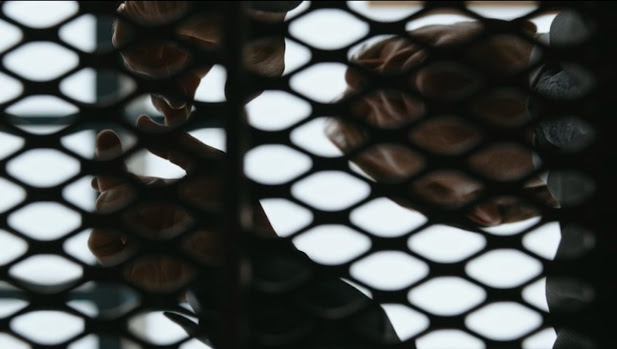
Then we shift to a back and forth of shots of each of them individually as seen through the mesh of the outdoor table at which they're sitting. In dialogue, Jimmy agrees to tell her the truth about what he’s doing no matter what, and she promises to accept it. It’s their "real" marriage vows, in a sense. And yet shot through the bars of the table makes it look like they're each in jail (and separate). A brilliant commentary on what they're doing. 


The sequence rolls on through a discussion with the county clerk and one of the witnesses, each moment of which only adds to the sense of this wedding as doomed, romance-less calculation. The next beat builds wonderfully on that; waiting in court for the judge, the two sit together not in the gallery but at the defense table. It's the perfect expression both of what this wedding is, a defense strategy, and of their plight.  


If you just had this shot to go on, you would absolutely think the two of them were in court either defending a client or themselves. 
 

Truly, the sequence could have ended with the judge walking in. It's the horrible shotgun wedding we feared, brilliantly delivered.


But instead, Tatlock has the characters say their vows. There's no frills to them, no added comments or words; they're just the standard pro forma formula. And yet face to face with each other and the reality of what they're doing, neither Jimmy nor Kim proves able to leave the moment at the level of legal protections. For each of them the vows becomes a quiet, unexpected, funny expression of their actual love. 


And just like that everything we’ve come to believe about this wedding is turned upside down.


507 has some other incredible moments, especially the ending, which again leads with a striking visual image--half of Jimmy's face reflected on a shiny wall to create this insane Jekyll and Hyde effect--  


-- that becomes the jumping off point for a stunning character turn, as Jimmy loses his mind all over Howard.

But for me, it's this moment, when everything said "This marriage is a disaster" and then their vows go exactly the other way, that I feel like I watched a great magic trick. 

Takeaways:
Stepping back, I take two big lessons from "JMM". 

First, How can I make this moment, this conflict, this character More Visual. Look for images, choreography, and other visual cues that can help reveal the internal state of your characters and their choices. It adds so much depth. 

Second, Consider what your audience is expecting. Tatlock knows that we left 506 thinking this wedding is a terrible idea. Playing into that at the top of 507 allows her to hide where the scene is headed. 

So much of good storytelling is about manipulation and misdirection. And that's what Tatlock does so brilliantly here.

TOMORROW: BOJACK HORSEMAN